The Power of Unified eClinical Platforms: How All-in-One Solutions with API Integration Are Transforming Clinical Trials
June 12, 2025
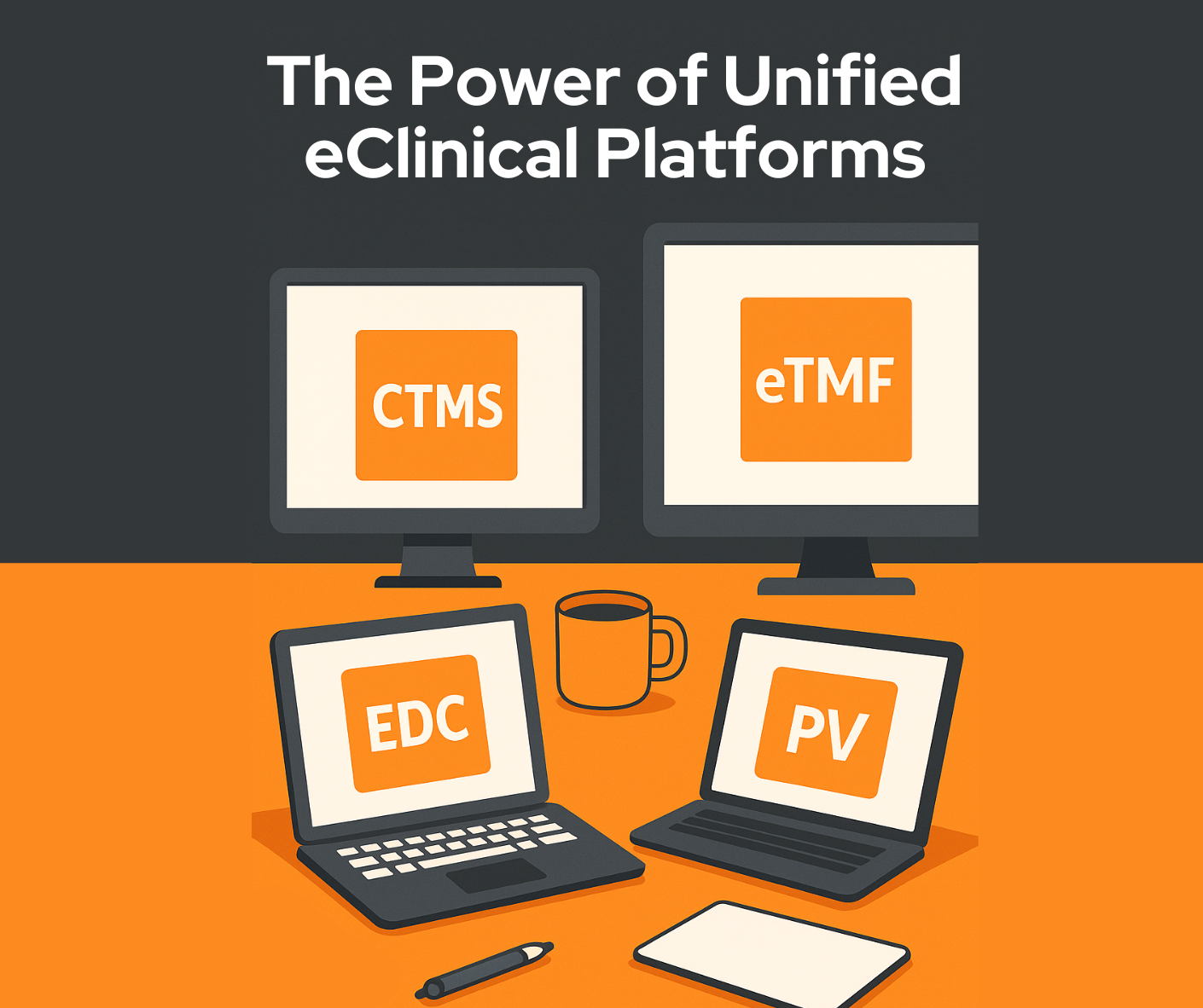
Inside the Toolbox: eTMF, CTMS, PV, and EDC
Running clinical trials today involves more than collecting data or monitoring patient visits. It’s about keeping everything connected, compliant, and on schedule while managing growing complexity. That’s where unified eClinical platforms come in, and at the core of these systems are several essential modules: eTMF, CTMS, PV, and EDC. Each plays a vital role but it’s how they work together that makes all the difference.
At Flex Databases, we offer a truly all-in-one eClinical suite, where each module is powerful on its own and even more impactful when used as part of a connected system.
eTMF (Electronic Trial Master File)
The eTMF is the heart of clinical trial documentation. It stores all the essential documents required to demonstrate GCP compliance. Flex Databases’ eTMF goes far beyond simple document storage. It offers:
- AI-assisted document classification and metadata assignment
- Real-time completeness tracking and audit readiness
- Role-based access and permissions
- Custom templates and drag-and-drop uploads
By reducing manual work and increasing control, our eTMF helps teams stay compliant without losing speed.
CTMS (Clinical Trial Management System)
Your CTMS is your operational command center. It helps manage sites, studies, investigators, vendors, and timelines. Flex Databases’ CTMS includes:
- Real-time tracking of study milestones and site performance
- Automated visit planning and monitoring trip reports
- Budget and invoice management
- Resource and workload allocation
With everything in one place, your team gains transparency and better decision-making capabilities from day one.
PV (Pharmacovigilance)
Safety monitoring is critical and increasingly complex. Flex Databases’ PV module simplifies case intake, processing, and reporting with:
- Automated case triage and tracking
- ICH E2B(R3) compliance
- Integration with safety databases and regulatory gateways
- Audit trail and version control
Whether you’re a sponsor or CRO, our PV tools keep patient safety at the forefront while reducing compliance risks.
EDC (Electronic Data Capture)
Flex Databases offers a fully integrated, native EDC system with RTSM, RBM, and ePRO included out of the box. That means:
- Study builds launch in as little as 3 weeks, with zero-code eCRF design via drag-and-drop tools
- EDC data flows natively into CTMS for site monitoring and subject tracking, and into eTMF for document filing — no third-party integration needed
- Safety data can flow into PV for case processing
- Built-in randomization (RTSM), risk-based monitoring, and patient-facing ePRO apps come standard, with no need to stitch together separate vendors
- Export to CDISC SDTM, SAS, and XML formats, with compliance to 21 CFR Part 11, GCP, HIPAA, and GAMP5
- Scales to 500,000+ subjects per study
- Prefer to keep your existing EDC vendor? Flex Databases also integrates with third-party EDC systems via robust APIs, so you’re never locked in
The Inefficiencies of Disconnected Systems
When clinical trial teams rely on disconnected systems, they spend more time juggling platforms than actually running trials. Data has to be manually transferred from one tool to another, documents get duplicated or lost, and teams often work in silos. For example, if your CTMS doesn’t speak to your eTMF, you might find yourself uploading the same visit report twice or worse, forgetting to upload it at all. These gaps lead to delays, errors, and extra work, especially when audits or inspections come up. Instead of focusing on patients and results, teams get caught in a maze of copy-pasting, backtracking, and chasing updates.
Disadvantages of disconnected systems:
- Manual data entry and duplicate work
- Increased risk of human error
- Poor collaboration between teams
- Delayed timelines and bottlenecks
- Audit and inspection readiness issues
- Lack of real-time visibility across trials
Advantages of Using a Unified eClinical Platform
A unified eClinical platform changes that completely. When all your core tools eTMF, CTMS, PV, and EDC are part of the same ecosystem or connected through smart API integrations, everything flows naturally. Site visit reports feed straight into your TMF. Subject data updates your CTMS in real time. Safety cases are automatically triggered from source data. Flex Databases brings all of this into one space, so teams work faster, stay aligned, and reduce compliance risks. Instead of fighting with systems, you gain time to focus on what matters: running better trials.
Advantages of a unified platform:
- Seamless data flow between modules
- Fewer manual steps and reduced errors
- Real-time trial oversight and reporting
- Centralized documentation and version control
- Better team collaboration and task visibility
- Faster audits and inspection readiness
- Scalable setup that adapts to trial complexity
How API Integration Enhances Tool-to-tool communication and Scalability
No matter how great your eClinical platform is, it rarely works in a vacuum. Most clinical trials use a mix of systems: an EDC from one vendor, a safety database from another, maybe even a custom portal for lab results. That’s where API integration comes in. It’s what makes all these tools talk to each other smoothly, without you needing to manually move data from one place to another.
At Flex Databases, we built our platform to be open and flexible. Every module whether it’s eTMF, CTMS, or PV can connect to any system through API. That means you can keep using the tools you already like, while letting Flex Databases tie everything together in the background.
Why does this matter? Because API integration:
- Lets your systems share data instantly, so nothing gets lost or delayed
- Makes it easy to scale up when your trial gets more complex or new tools are added
- Gives you the freedom to choose the best tools for each task without locking you into a single vendor
- Automates everyday actions, like filing documents or updating subject data, saving your team hours of manual work
- Helps you stay audit-ready, with consistent data and a clear trail across all platforms
In simple terms, API integration is what keeps your tech stack working like a team – not a group of strangers. And when your tools are in sync, your trial runs faster, smoother, and with far less stress.