Clinical Trials Management Software: Key Features for CROs
May 19, 2026
CROs work in a fast-moving and highly complex environment. They manage multiple studies at the same time, often for different sponsors, across different countries, sites, and timelines. Each study comes with its own processes, reporting needs, and regulatory expectations. As this complexity grows, it becomes harder to keep everything aligned using separate tools or spreadsheets and emails.
This is where clinical trials management software becomes important. It gives CRO teams a single place to track studies, manage operations, and see what is happening in real time. Instead of jumping between systems or chasing updates, teams can focus more on execution and decision-making. In the end an unified system helps to cut study costs, save time and efforts, and stay compliant.
In this article, we will look at the key features CROs typically need in clinical trials management software, and why these capabilities matter in day-to-day operations.
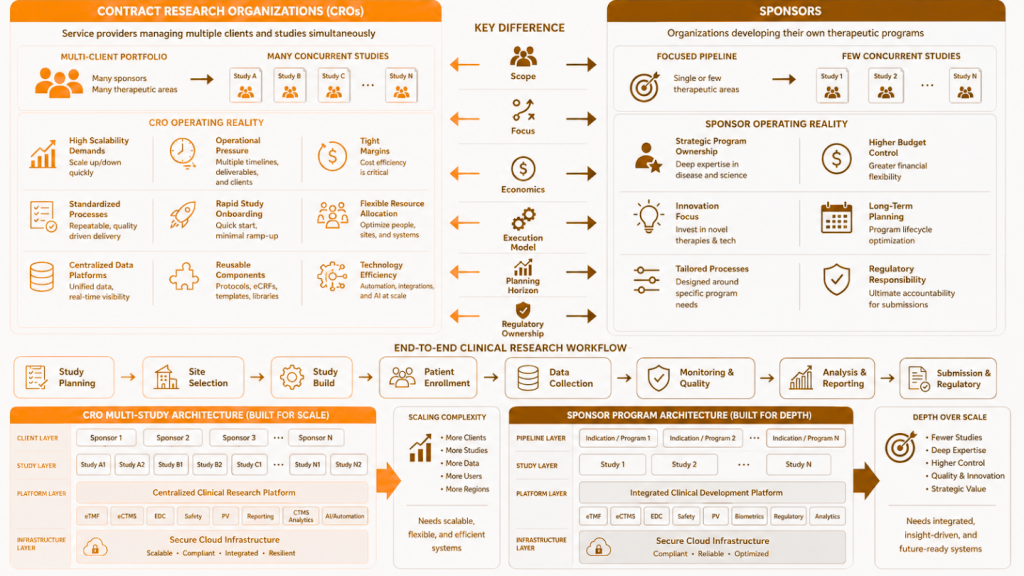
Why CROs Have Different Requirements Than Sponsors
Clinical trials management software is often used in CRO environments where multiple sponsors are handled at the same time. Each sponsor brings different processes, reporting formats, and expectations. Because of this, the software must allow clear separation of data and configurations while still keeping day-to-day work efficient and centralized.
Multi-Study Environments
In most CRO operations, work is not limited to a single study. Several studies run in parallel across different phases, countries, and therapeutic areas. Clinical trials management software needs to provide a unified, real-time overview so teams can track progress, compare performance, and quickly identify risks across all studies.
Need for Scalability and Flexibility
Growth in a CRO setting usually means more sponsors, more studies, and more complexity. Clinical trials management software must scale without slowing down operations or forcing rigid workflows. At the same time, it needs to remain flexible enough to support different study designs and sponsor-specific requirements.
Operational Pressure and Margins
Efficiency has a direct impact on profitability in CRO operations. Delays, manual work, and disconnected tools quickly add up. Clinical trials management software helps reduce this pressure by standardizing processes, improving coordination across teams, and supporting faster, more informed decision-making.
Flex Databases helps reduce operational friction by connecting core clinical processes, such as study management, CRA activities, financial tracking, and document workflows, in a single system. This removes the need to switch between tools or manually transfer data, which often leads to duplication and delays. By automating routine updates and keeping all stakeholders aligned in real time, teams can execute faster, reduce errors, and maintain better control across multiple studies.
Centralized Study Management in Clinical trials
Managing clinical studies through separate tools often leads to scattered information and missed context. When updates live in different systems or inboxes, it becomes harder to understand the full picture of what is happening across a study.
A centralized approach to clinical trials management software brings everything together in one place. Study data, activities, and updates are visible in a unified environment, which makes it easier for teams to stay aligned and maintain control across multiple studies at once.
Timeline and Milestone Tracking
Timelines in clinical trials are rarely static. Milestones shift, dependencies change, and updates come from different stakeholders. Without a clear structure, it’s easy for delays to go unnoticed until they become critical.
With clinical trials management software, timelines and milestones can be tracked in real time. Teams get a clear view of study progress, upcoming deadlines, and potential bottlenecks, helping them react earlier instead of responding after issues escalate.
Task and Workflow Visibility
Day-to-day execution in clinical trials depends on many small but connected tasks across different roles. When visibility is limited, it becomes difficult to understand who is doing what, and whether activities are on track.
A structured system improves this by making tasks and workflows transparent. Teams can see ownership, track progress, and understand dependencies between activities, which helps reduce miscommunication and improves coordination across functions.
Spreadsheet Dependency in Clinical Studies
Spreadsheets are still widely used in clinical operations because they are flexible and familiar. However, as studies grow in size and complexity, they quickly become difficult to maintain. Version conflicts, manual updates, and limited visibility often lead to inefficiencies and errors.
Modern clinical trials management software reduces this dependency by replacing manual tracking with structured, real-time data. Information is updated in one place, which improves accuracy and removes the need to constantly reconcile multiple versions of the same dataset.
Site and Investigator Management
Central Investigator Database
In many CROs, investigator information ends up scattered across files, emails, and different systems. Over time, this makes it harder to reuse experience or quickly find the right sites for new studies.
Clinical trials management software fixes this by keeping all investigator and site information in one place. Teams can easily see who has worked on what, what their experience is, and whether they are a good fit for a new study.
Site Qualification Tracking
Selecting a site is never just a checkbox exercise. It depends on past performance, therapeutic experience, and how reliable the site has been in previous studies. When this information isn’t tracked properly, decisions become slower and less consistent.
With clinical trials management software, site qualification becomes a clear, structured process. Everything from initial assessment to final approval is recorded, so teams always know which sites are ready and why.
Performance Analytics
After a study starts, it’s important to understand how each site is actually performing. But in reality, this information is often spread across reports, spreadsheets, and different team notes.
A centralized system brings this together. It becomes easier to see which sites are performing well, which ones need more support, and which ones might not be the right fit for future studies.
Communication Management
Communication with sites never really stops during a study. The problem is that important context often gets lost in email threads or shared across too many channels.
Clinical trials management software helps keep all communication in one place. This makes it easier for teams to follow what was discussed, what was agreed, and what still needs to be done.
How Flex Databases helps
Flex Databases supports site and investigator management by bringing everything into one connected system. CRO teams can:
- Maintain a centralized investigator and site database
- Track site history across multiple studies and sponsors
- Manage site qualification in a structured, transparent way
- Monitor site performance over time with consistent data
- Keep communication linked directly to site and study records
- Connect operational activity with site-related information in one place
This reduces the need to switch between tools or spreadsheets and helps teams select the right sites faster while maintaining stronger oversight throughout the study lifecycle
CRA and Monitoring Management
Monitoring activities are tightly linked to study timelines, site readiness, and CRA availability. When planning is handled manually or across separate tools, it’s easy for visits to overlap, get delayed, or lack proper coordination.
Clinical trials management software helps organize visit planning in a structured way. Teams can schedule monitoring visits based on study progress, track upcoming activities, and maintain better alignment between CRAs, sites, and project managers.
Monitoring Report Management
Monitoring reports are a key part of oversight, but they often end up stored in different formats and locations. This makes it difficult to get a clear view of what has been done and what still needs attention.
With clinical trials management software, monitoring reports are stored and managed in one place. This creates a consistent view of monitoring activity across studies and makes it easier to track progress over time.
Follow-Up Tracking
After a monitoring visit, there are usually multiple follow-up actions from resolving findings to ensuring site compliance. When these are tracked manually, some actions can easily be missed or delayed.
A centralized system helps keep follow-ups visible and accountable. Teams can see what needs to be done, who is responsible, and whether actions are completed on time.
Remote monitoring support
Remote and hybrid monitoring has become a standard part of clinical operations. However, it requires good access to real-time data and clear visibility into site activity.
Clinical trials management software supports remote monitoring by making key study information accessible in one place. This helps CRAs stay informed without needing constant site visits or manual data requests.
What We Offer?
Flex Databases supports CRA and monitoring workflows by connecting visit planning, monitoring reports, and follow-up tracking in one system. CRAs can schedule visits, document findings, and track actions without switching tools, while study teams get real-time visibility into monitoring progress. This makes monitoring more structured, reduces administrative workload, and helps ensure issues are addressed faster across all studies.
Financial and Payment Management
Site payments management in clinical trials can quickly become complex, especially when different visit schedules, country rules, and sponsor agreements are involved. Delays and inconsistencies always appear when payments are tracked manually.
Clinical trials management software helps standardize site payment processes. It keeps payment rules, visit data, and approvals connected, so teams can process payments more accurately and with fewer delays.
Sponsor Invoicing
In order to properly invoice sponsors teams often require to pull data from multiple sources, such as study progress, completed visits, CRA activity, and budget agreements. When this information is fragmented, invoicing becomes slow and may cause human errors.
With clinical trials management software, invoicing is based on structured study data. This makes it easier to generate accurate invoices and reduces the need for manual reconciliation between finance and operational teams.
Budget Forecasting
Budgets in clinical trials are not static. They change as studies evolve, enrollment shifts, or timelines are adjusted. Without a clear system, forecasting becomes guesswork rather than planning, doesn’t it?
A centralized platform allows teams to track budget consumption in real time and adjust forecasts based on actual study progress. This gives CROs better control over financial planning and resource allocation.
Financial Transparency
Without a unified system, financial data is often split between departments, making it difficult to get a clear view of overall study costs and performance.
Clinical trials management software improves transparency by connecting operational and financial data in one place. This helps both internal teams and sponsors understand where money is being spent and how it relates to study activity.
How Flex Databases Can Help Your Team?
Flex Databases connects financial management directly with study operations, so site payments, invoicing, and budget tracking are based on real study activity. CRO teams can link visits, milestones, and CRA work to financial data, reducing manual calculations and reconciliation. This improves accuracy, speeds up financial processes, and gives both CROs and sponsors a clearer, real-time view of study costs.
Multi-Sponsor and Role-Based Access
Data Separation Between Sponsors
CROs often work with multiple sponsors at the same time, and each sponsor expects their data to remain fully separate and secure. When systems are not designed properly, there is a risk of confusion, overlap, or unnecessary duplication of environments.
Clinical trials management software helps solve this by keeping sponsor data clearly separated within the same platform. Teams can manage multiple clients in parallel without mixing information or creating isolated systems for each study.
Permission Management
Not every user needs access to all information. CRAs, project managers, finance teams, and sponsor users all work with different levels of detail. Without proper control, access can become either too limited or too broad.
A structured system allows role-based permissions, so each user only sees what they need for their work. This improves both efficiency and data security while keeping workflows clean and controlled.
Sponsor Portals and Visibility
Sponsors expect visibility into study progress, but they don’t always need full access to internal operational details. Balancing transparency with control can be difficult when using separate tools or manual reporting.
Clinical trials management software can provide dedicated sponsor access, giving them real-time visibility into key study metrics, progress updates, and relevant documents without exposing internal workflows.
Secure Collaboration
Clinical trials involve constant collaboration between CRO teams, sponsors, and sites. When collaboration happens across emails and disconnected tools, important context can be lost and communication becomes harder to track.
A centralized system supports secure collaboration by keeping communication, documents, and study activity in one controlled environment. This ensures that everyone works with the same information while maintaining compliance and data security.
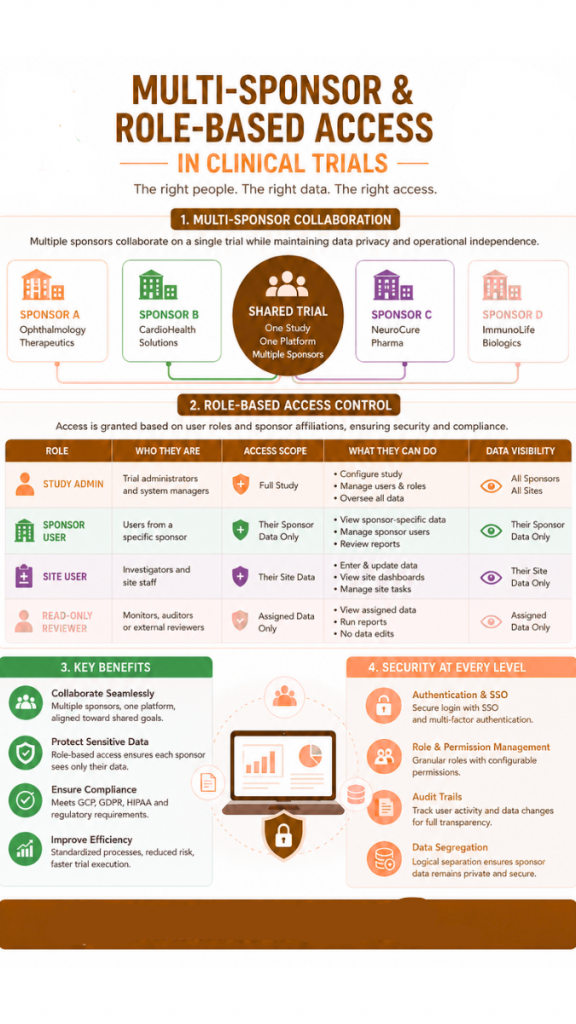
How Flex Databases Helps
Flex Databases enables CROs to manage multiple sponsors within a single platform while keeping data fully separated and secure. Role-based access ensures each user sees only relevant information, while sponsor-specific views provide transparency without compromising internal processes. This allows CROs to collaborate efficiently across all stakeholders while maintaining full control over data, permissions, and compliance requirements.
eTMF and System Integration
In many organizations, clinical data, operational tasks, and document management live in separate systems. At first, this may seem manageable, but over time it creates gaps. Teams end up re-entering the same information in different places, chasing updates, or working with outdated documents.
Clinical trials management software helps reduce this fragmentation by bringing core processes closer together and reducing reliance on disconnected tools.
CTMS + eTMF Benefits
CTMS and eTMF work separately, operational data and trial documentation often drift apart. This makes it harder to maintain consistency between what is happening in a study and what is officially documented.
Connecting clinical trials management software with eTMF functionality helps align operations and documentation. Study activities can be directly linked to essential trial documents, improving traceability and inspection readiness.
API Integrations with EDC and Other Systems
Clinical trials rarely rely on a single platform. Systems like EDC, safety databases, and external reporting tools all play a role. Without integration, teams spend time manually transferring data between systems.
Modern clinical trials management software supports API integrations, allowing data to flow between systems automatically. This reduces manual entry, improves data consistency, and keeps all stakeholders working with the same information.
Duplicate Work Issue
When systems are not connected, the same information often has to be entered multiple times by different teams. This not only wastes time but also increases the risk of inconsistencies.
Integrated clinical trials management software reduces duplication by ensuring that once data is entered, it can be reused across workflows, reporting, and documentation without rework.
Flex Databases combines CTMS and eTMF capabilities within a single ecosystem and supports integrations with external systems through APIs. This allows CROs to connect operational data, trial documentation, and third-party platforms without breaking workflows. As a result, teams reduce duplicate work, improve data consistency, and maintain a clearer link between study execution and documentation throughout the trial lifecycle.
Configurability and Workflow Flexibility
Different CRO Processes
No two CROs work exactly the same way. Even within one organization, processes can vary depending on the sponsor, study phase, or therapeutic area. This makes it difficult for rigid systems to support real operational needs without constant workarounds.
Clinical trials management software needs to adapt to these differences instead of forcing teams into a fixed way of working.
Configurable Forms and Dashboards
Day-to-day work in clinical trials depends heavily on forms, tracking tools, and dashboards. If these are hard-coded or require development support, even small changes become slow and expensive.
Flexible clinical trials management software allows teams to adjust forms, fields, and dashboards without heavy technical involvement. This helps teams respond faster to new requirements and reporting needs.
Study-Specific Workflows
Different studies often require different workflows — from startup processes to monitoring and approvals. A one-size-fits-all approach usually leads to inefficiencies or unnecessary manual steps.
With configurable workflows, clinical trials management software can be adapted to match each study’s structure. This keeps processes aligned with reality rather than forcing teams to adjust how they work.
Avoiding Expensive Customization Projects
Traditional systems often rely on customization projects for even minor changes. This slows down implementation and increases long-term costs.
Modern platforms reduce this dependency by offering built-in flexibility. Instead of building custom solutions for every change, teams can configure the system directly, saving both time and budget.
Flex Databases is designed to be highly configurable, allowing CROs to adapt workflows, forms, dashboards, and study structures without relying on costly development projects. This flexibility helps teams align the system with real operational processes, adjust quickly to sponsor requirements, and avoid the limitations of rigid, one-size-fits-all software.
Reporting and Analytics
Enrollment Tracking
Tracking enrollment across multiple studies is one of the most important indicators of trial progress. When data is spread across different tools or updated manually, it becomes difficult to see real-time recruitment status.
Clinical trials management software provides a clear view of enrollment across all studies, helping teams understand where recruitment is on track and where delays are starting to build.
Site Performance Metrics
Not all sites perform at the same level. Some recruit faster, deliver cleaner data, and require fewer follow-ups, while others may consistently slow down study progress.
With structured reporting in clinical trials management software, site performance can be tracked over time. This makes it easier to identify strong sites, support underperforming ones, and make better decisions for future studies.
Operational KPIs
CROs rely on key performance indicators to manage efficiency, timelines, and resource allocation. Without centralized reporting, KPIs often come from different sources and lack consistency.
A unified system allows operational KPIs to be calculated and monitored in one place, giving teams a more accurate and up-to-date view of study performance.
Risk Identification
Many issues in clinical trials start small: a delayed visit, missing documentation, or slow site response, but can escalate if not detected early.
Clinical trials management software helps highlight these risks by consolidating operational data and making deviations easier to spot. This allows teams to react earlier and keep studies on track.
Flex Databases provides built-in reporting and analytics tools that bring enrollment data, site performance, KPIs, and operational insights into one view. CRO teams can monitor study progress in real time, identify risks earlier, and make data-driven decisions without relying on manual reporting or fragmented data sources.
Compliance and Inspection Readiness
In clinical trials, every action needs to be traceable. When information is edited or updated across different tools, it becomes difficult to clearly understand who did what and when.
Clinical trials management software automatically records audit trails for key actions. This creates a transparent history of changes, which is essential for both internal control and regulatory inspections.
Electronic Signatures
Approvals are a routine part of clinical operations from document sign-offs to workflow confirmations. If these are handled outside the system, it can create gaps in traceability and slow down processes.
With clinical trials management software, electronic signatures are built into workflows, allowing teams to approve tasks and documents in a controlled, compliant, and efficient way.
Validation Support
Validated systems are a key requirement in regulated environments. Without proper validation support, implementation becomes complex, time-consuming, and risky from a compliance perspective.
Clinical trials management software designed for regulated use helps streamline validation processes by providing structured documentation, controlled changes, and system transparency.
Regulatory Expectations
Regulatory authorities expect clear, consistent, and accessible documentation across the entire trial lifecycle. When data is fragmented, preparing for inspections becomes stressful and time-consuming.
A centralized system helps maintain compliance by keeping all operational and documentation data aligned and easily accessible when needed.
Flex Databases supports compliance and inspection readiness by providing audit trails, electronic signatures, and validation-friendly system design within a single platform. CROs can maintain full traceability of actions, ensure controlled approvals, and keep all trial data organized in a way that aligns with regulatory expectations, making inspections more straightforward and less disruptive.
Common Mistakes When Choosing Clinical Trials Management Software
It’s easy to assume that well-known platforms are automatically the best fit. In reality, big names don’t always match how a CRO actually works day to day. What matters more is whether the system fits operational needs, not just its reputation.
Clinical trials management software should be evaluated based on functionality, flexibility, and real workflows not only brand visibility.
Configurability Ignoring
Some systems look strong in demos but turn out to be rigid once implementation starts. If workflows, forms, or reports cannot be adjusted easily, teams often end up changing their processes to fit the system instead of the other way around.
Good clinical trials management software should adapt to CRO processes, not force CROs into fixed templates.
Underestimation of Implementation Complexity
Implementation is often more challenging than expected. Data migration, user adoption, integrations, and validation all take time and coordination. This is frequently overlooked during the selection phase.
A realistic understanding of implementation effort helps avoid delays and frustration later in the project.
Focus on Current Needs Only
When you choose a system based only on today’s requirements can become a limitation later. As CROs grow, they need more studies, more sponsors, and more advanced workflows.
Clinical trials management software should support long-term scalability, not just solve immediate problems.
Flex Databases addresses these challenges by offering a configurable platform that can adapt to different CRO processes without heavy customization. It supports scalable study management, flexible workflows, and integrated modules, helping organizations avoid rigid systems, reduce implementation surprises, and choose a solution that grows with their operational needs.
FAQ
Why do CROs need Clinical Trials Management Software?CROs use Clinical Trials
Management Software to handle multiple sponsors and studies efficiently while reducing fragmented tools and manual processes.
How is Clinical Trials Management Software different for CROs vs sponsors?
For CROs, Clinical Trials Management Software must support multi-sponsor operations, higher scalability, and flexible workflows across many parallel studies.
What core areas does Clinical Trials Management Software centralize?
It centralizes study oversight, site and investigator management, CRA activities, financial tracking, reporting, and compliance processes.
Does Clinical Trials Management Software support site and investigator management?
Yes, it supports centralized investigator databases, site qualification tracking, and performance monitoring across studies.
How does Clinical Trials Management Software support CRA and monitoring work?
It helps manage visit planning, monitoring reports, and follow-up actions in a structured and trackable way.
Can Clinical Trials Management Software improve reporting and analytics?
Yes, it provides real-time visibility into enrollment, site performance, and operational KPIs across studies.
Is Clinical Trials Management Software important for compliance?
Yes, it supports audit trails, electronic signatures, and inspection-ready documentation.
Does Clinical Trials Management Software integrate with other systems?
Yes, it can integrate with systems like eTMF, EDC, and other clinical tools through APIs.
Why is configurability important in Clinical Trials Management Software?
Because CRO processes vary, Clinical Trials Management Software must adapt to different workflows without requiring costly customization.
How does Flex Databases support Clinical Trials Management Software needs?
Flex Databases provides a configurable Clinical Trials Management Software platform that connects study operations, monitoring, financials, and reporting in one system, helping CROs reduce complexity and manage multi-sponsor studies more efficiently.