The Quiet Revolution in TMF: How AI Document Classification Turns Routine into a Background Task
June 25, 2026
AI in Trial Master File management has quietly stopped being a someday idea. It’s not a pilot and it’s not a roadmap promise – it’s something clinical teams reach for on an ordinary Tuesday. The interesting part isn’t that AI can file a document; it’s how calmly and predictably it does it now – with logic you can actually see, a person keeping watch, and a difference you can feel in the team’s week. So let’s talk numbers, and how this plays out in real life.
What Changes in the Document Workflow
For years, every document took the same slog into the TMF, no matter how it arrived. Someone opened it, worked out which folder and zone it belonged in, typed in the metadata, and confirmed. With AI, that slog mostly disappears from the human’s day.
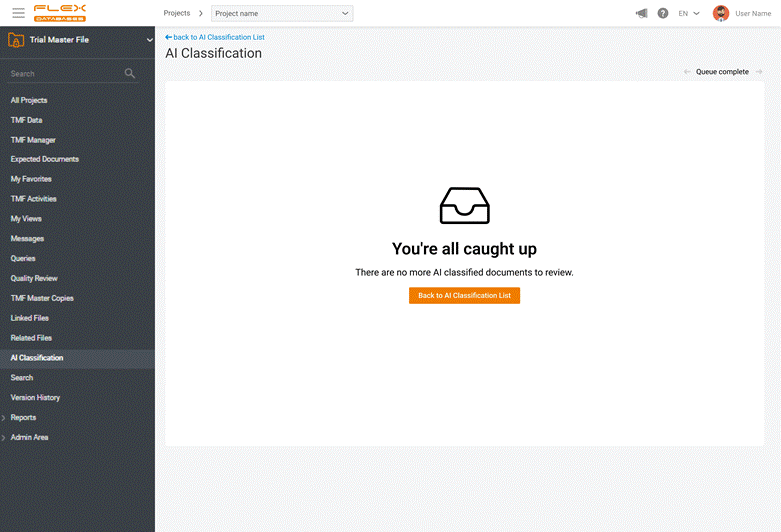
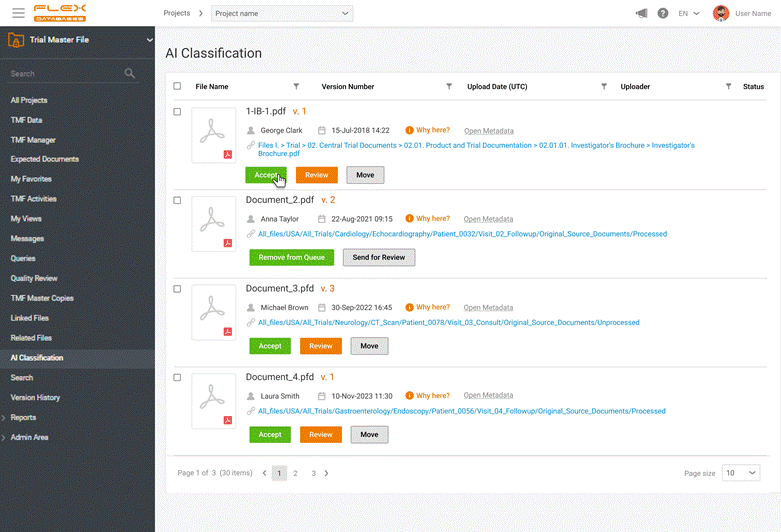
You still send documents however suits you: snap a photo on your phone and email it to the eTMF, forward it from your inbox, drag and drop it, or push it through one of the eTMF screens. From there the AI takes the wheel: it works out where the document belongs and fills in the metadata. All that’s left for you is a quick yes or no – tick if it’s right, decline if it isn’t, and the system offers up the next best home for the file.
That’s the co-pilot idea in a sentence: the AI does the mechanical grunt work, you stay in charge of the outcome.
What It Saves in Real Numbers
Let’s make this concrete. Filing one document by hand – metadata and all – takes about 4–5 minutes. At a typical in-house EU rate of €40 an hour, that’s roughly €3.3 of someone’s time for every single document, just to put it where it belongs. On its own, that’s nothing. Stretched across a year, it adds up fast.
| 5 min saved on every document | 80%+ filed automatically after tuning | 6,600 h freed a year (large sponsor) | €267k saved a year (large sponsor) |
Headline figures for a large sponsor. Smaller organizations scale down proportionally – see the tables below.
Annual Manual Workload by Organization Type
| Client profile | Documents / year | Manual time / year | Annual cost @ €40/h |
| Sponsor F (large portfolio) | 100,000 | ~8,300 h | ~€333,000 |
| CRO (large) | 60,000 | ~5,000 h | ~€200,000 |
| Biotech (small) | 10,000 | ~830 h | ~€33,000 |
Based on ~5 minutes per document at an in-house EU rate of €40/hour. Volumes depend on the operating model – the figures assume each organization maintains its own TMF.
It’s worth pausing on the sponsor, because the volume tends to surprise people. A sponsor running a full pipeline usually spreads its studies across several CROs and every one of those studies eventually funnels documents back into the sponsor’s own TMF.
So the sponsor isn’t a small player here; it’s the place where all the paperwork converges. For a sponsor that keeps its own TMF across a broad portfolio, the document count and the savings can be the largest of the three.
Realistic Savings with AI
AI doesn’t hit 100% automation, and we won’t pretend it does. Out of the box, around 65% of documents are filed automatically; after a bit of tuning during setup, that climbs to 80%+. The table below uses a deliberately conservative 80% to show what actually lands back on the bottom line.
| Client profile | Hours freed / year | Cost saved / year | FTE freed* |
| Sponsor F (large portfolio) | ~6,600 h | ~€267,000 | ~3.5 |
| CRO (large) | ~4,000 h | ~€160,000 | ~2.1 |
| Biotech (small) | ~670 h | ~€26,700 | ~0.35 |
*FTE freed = hours freed ÷ ~1,900 productive hours per year, for the filing task specifically. Savings shown at 80% automation after tuning.
An Illustrative Example
Picture “Sponsor F” – a pharma company with a busy pipeline, running a dozen studies at once and leaning on several CROs to deliver them. Every one of those studies sends documents back to “Sponsor F’s” TMF, and all of it has to be filed, checked, and kept inspection-ready.
That’s roughly 100,000 documents a year – about 8,300 hours, or the equivalent of more than four people doing nothing but sorting paperwork. None of it moves a molecule closer to approval; it simply has to be right.
After switching on AI-assisted filing and tuning the rules during setup, about 80% of those documents land in the right place on their own, with the team just confirming or correcting each suggestion. That hands back roughly 6,600 hours and €267,000 a year (close to three and a half full-time roles’ worth of capacity) which Sponsor F’s people pour into the work that genuinely needs a human: chasing the documents that never arrived, untangling the odd edge case, and staying ready for an inspection at any moment. The last 20% – the bad scans, the wet-ink originals, the document nobody can place at first glance – still gets human eyes, which is exactly where they belong.
And here’s the part that matters most: AI speeds all this up without cutting corners. It isn’t doing the same work more carelessly and faster – it simply doesn’t need vacations, coffee breaks, or a moment to clear its head. It just keeps going, steadily and at the same pace, while a human stays in the loop.
Transparency: AI Now Explains Its Decisions
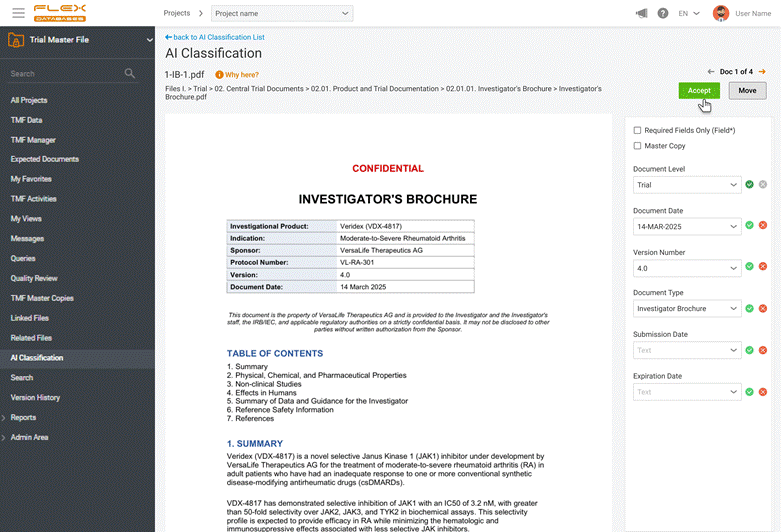
People don’t trust what they can’t see, and “the computer decided” has never reassured anyone. That’s why reasoning matters so much: the AI shows its working – the basis on which it reached a conclusion.
Take a small, real example. To work out which country a document belongs to, the system points at concrete clues: the signing timestamps are in EST (US Eastern time), the sponsor’s representative is named as president of a company headquartered in the United States, and the document’s own context points to the US. You’re not staring at a verdict from a black box – you’re reading a short chain of reasoning you can check, and challenge if it’s off.
Which Rules Work, and How Accurately
It’s more useful to be straight about accuracy than to make pretty promises. Out-of-the-box rules get you about 65% of documents filed correctly with no setup at all. Fine-tune them for a specific client during implementation and that rises to 80%+.
That’s not 100%, and saying so plainly is the honest thing to do. Rules come in three
- flavors: standard out-of-the-box,
- automated,
- and the manual ones tailored to a client, which do the heavy lifting.
Even then, people review the rules periodically not as a nice-to-have, but as part of the human-in-the-loop approach the industry expects.
Where AI Gets It Wrong and How That’s Handled
An honest look at any tool includes its weak spots. The documents that don’t classify on their own fail for reasons that won’t surprise anyone who’s worked a TMF:
- Bad scans – image quality so poor it’s hard to read;
- Handwritten signatures and wet-ink markings – the kind of thing machines still wrestle with;
- Documents with no data – the ones where even a person has to stop and ask what this is and where it goes.
The answer to all of that isn’t blind faith in the AI – it’s control built into the process. Like any of us, AI can hallucinate: produce something confident and wrong. The difference is that in a validated, regulated environment those slips can be prevented or caught in time thanks to built-in controls, an audit trail that logs everything that happened, and a human who signs off on the final call.
None of this is at odds with the regulators – it’s exactly what they ask for. EMA’s guidance on good AI practice in drug development is explicit: an AI output shouldn’t be accepted just because a machine produced it. Qualified people are expected to weigh the reasoning and context behind it, whether it’s plausible, how good the source data is, and what could go wrong – while the final decision, and the accountability for it, stays with authorized humans.
Validation
At Flex Databases we validate the whole business process, not the AI model on its own. We take a risk-based view, focused on how AI decisions affect data integrity, document completeness, and regulatory compliance, and we hand customers ready-made validation documentation, traceability, testing evidence, and support across the full lifecycle. Accountability for TMF quality stays where it should (with the users and process owners) because AI here is a tool for automation and decision support, not a stand-in for a person. We’ll go deeper on validation in a separate article.
Bottom Line
AI in the TMF isn’t the shiny breakthrough from a conference keynote. It’s a quieter, more useful thing: a tool that already lifts thousands of hours of busywork off people’s plates every year, shows its reasoning, and is honest about what it can’t do. It isn’t here to replace anyone – it’s here to hand the mechanical work to a machine and leave the judgment to people. AI isn’t going anywhere, and the teams that treat it as a controlled, well-watched assistant will simply move faster than the ones that don’t.