More Studies, More Costs? Rethinking eClinical Total Cost of Ownership
November 18, 2026

When choosing eClinical software, CROs hear familiar promises: seamless integrations, flexible workflows, and low total cost of ownership.
But once the demos end and contracts are signed, reality sets in. There’s a world of difference between a platform that glues separate systems together and one built from the ground up as a unified whole.
And as your study portfolio grows, that difference starts hitting your budget.
A CTMS-Centric System Isn’t the Same as a Unified Platform
The issue:
Many eClinical vendors build their platforms around a central CTMS, trying to patch together EDC, Pharmacovigilance and other modules through external third-party integrations.
On paper, it looks like a complete, well-rounded ecosystem with varieties. In practice, every extra vendor relationship brings its own separate contract, integration fees, maintenance headaches, validation efforts, and endless data reconciliation work.
The Flex Databases Approach:
Flex Databases brings CTMS, eTMF, EDC, Project Management & Budgeting, Pharmacovigilance, LMS, and QMS together inside one truly unified eClinical platform.
Our interconnected modules allow data to flow naturally across your clinical operations without forcing you to rely on messy third-party connectors for every new workflow. This helps CROs slash integration costs, cut down on double data entry, and keep system maintenance remarkably simple.
Unified doesn’t mean closed, though. Flex Databases provides an API that makes it easy to connect the platform with the systems your team and your sponsors already use. You decide what to integrate and when – integrations become an option that adds value, not a requirement just to keep basic workflows running.
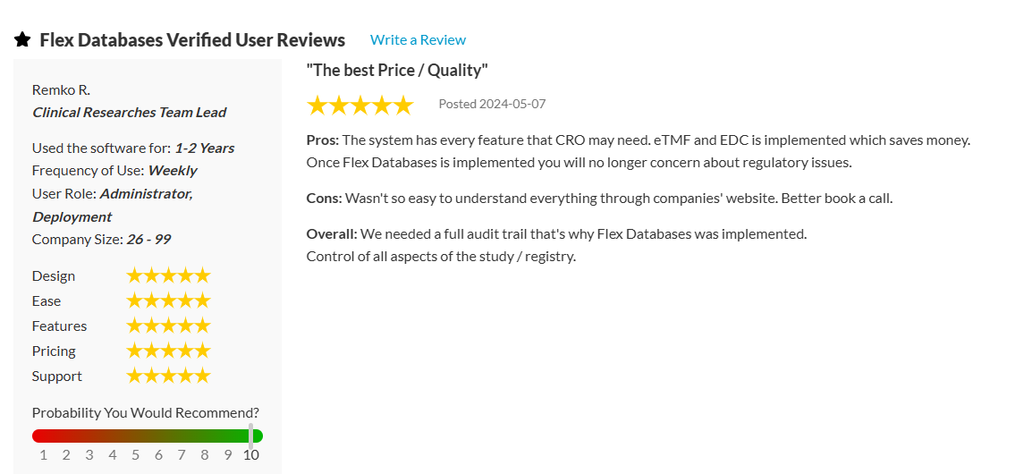
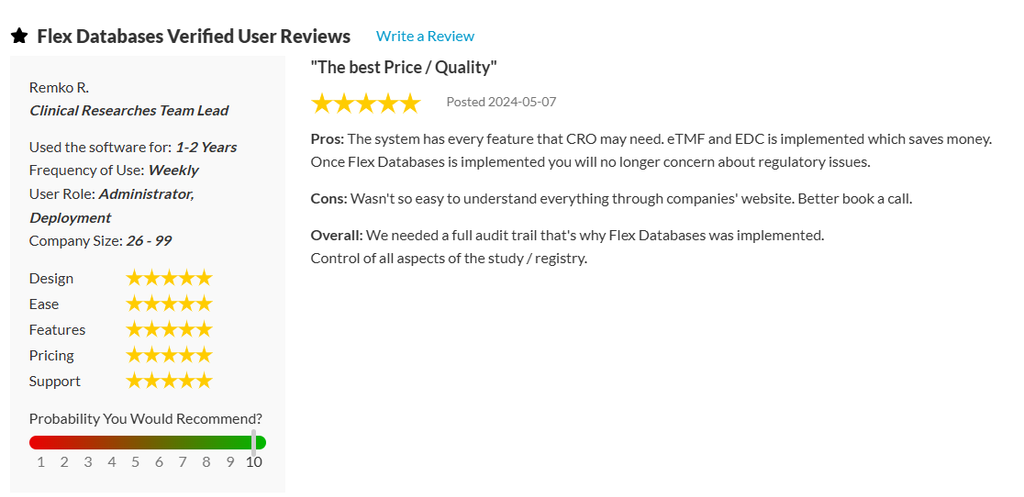
“The system has every feature that CRO may need. eTMF and EDC is implemented which saves money.”
– Remko R., Clinical Research Team Lead, review on SourceForge
Does a CTMS-Centric Platform Really Deliver the Lowest Total Cost of Ownership?
The issue:
A low initial software price tag is a great hook during the sales pitch. But what does the platform actually cost you once it’s up and running?
Hidden expenses – like extra integration fees, charges for specific features, training sessions, implementation services, and ongoing support – can quietly inflate your budget. The more systems and vendors you have in the mix, the harder it gets to predict what you’ll actually be spending next quarter.
The Flex Databases Approach:
Flex Databases gives you full access to all features within your selected modules without hitting you with surprise, feature-based surcharges.
Our implementation, training, and support setups are transparent from day one, featuring generous support hours and training customized specifically to your team’s workflows. That means you can plan your technology budget with real confidence, avoiding nasty financial surprises as your business scales.
“eTMF integrated – helps to save lot of money.”
– Quality Assurance Team Lead, review on SourceForge
Why Should Costs Grow with Every Study?
The issue:
Many pricing models tie your software costs directly to the number of active studies or investigative sites, making expansion unnecessarily punishing.
For CROs, this creates a frustrating trap: the more projects you win, the more you pay just to keep using the same software.
For sponsors, these growing costs can translate into higher study budgets, less predictable technology expenses, and additional costs when expanding into new sites or studies.
The Flex Databases Approach:
Flex Databases uses a straightforward pricing model based purely on users and chosen modules – with zero limits on the number of projects or sites you can run within your agreed terms.
For CROs, this means your effective software cost per study can decrease as your portfolio grows. Predictable expenses also make it easier to include eClinical costs in sponsor budgets and create additional revenue opportunities.
For sponsors, it means more predictable technology costs, greater flexibility to expand studies across additional sites, and fewer software-related cost surprises as trial requirements evolve.
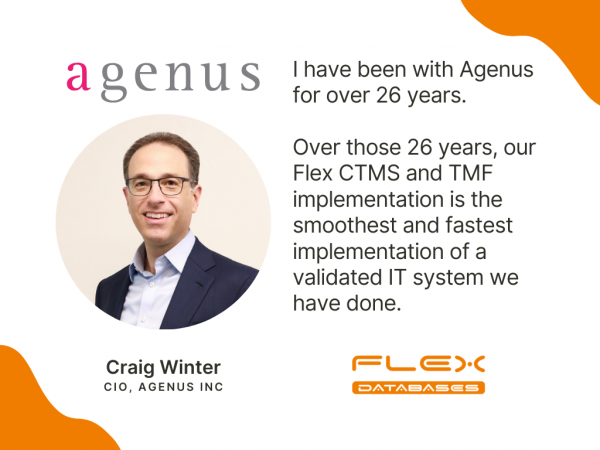
“Flex’s clear per-user pricing structure also ensures we avoid unplanned costs, even for extended trials.”
– Craig Winter, CIO, Agenus Inc.
Implementation Shouldn’t Become Another Expensive Project
The issue:
Software costs don’t stop the moment you sign. Implementation, validation, staff training, and ongoing support all demand serious time and internal resources.
Generic, one-size-fits-all training and fragmented vendor support slow down user adoption, while weak implementation guidance dumps extra work right back onto your internal teams. And when multiple vendors are involved, even a simple fix requires a frustrating amount of coordination.
The Flex Databases Approach:
Every Flex Databases client gets a dedicated Project Manager who stays with you from the day you sign right through the life of the partnership.
We provide a structured implementation process, complete validation documentation, guided walkthroughs, and personalized training built around your organization. With a single, consistent point of contact and crystal-clear support plans, you can cut out the administrative runaround and make rollouts predictable.
Validation and Hosting on Your Terms
The issue:
Every eClinical system used in clinical trials has to be validated – and validation is one of the most underestimated costs of a new platform. When vendor documentation is incomplete, CROs end up hiring external consultants or pulling QA staff away from their actual work to fill the gaps. With several vendors in the stack, this effort multiplies: each system needs its own validation, and each update can trigger another round.
Hosting is another hidden constraint. Many vendors offer only shared cloud infrastructure, which may not meet sponsor requirements, internal IT policies, or local data protection rules.
The Flex Databases Approach:
Flex Databases is designed to comply with 21 CFR Part 11 and GDPR, with a full audit trail across all modules. Because the platform is unified, you validate one system instead of several – and our team provides complete validation documentation and supports you through the entire process, so your QA team reviews and approves rather than builds everything from scratch.
You also choose how your data is hosted: in our secure cloud environment or on dedicated servers when your sponsors, internal policies, or regulations require full data isolation.
Switching Platforms Shouldn’t Mean Starting Over
The issue:
Many CROs stay with costly, fragmented systems simply because moving feels too risky. Years of study data, documents, and records live in the old platform, and migration sounds like months of manual work and disruption to ongoing studies.
The Flex Databases Approach:
Flex Databases handles migration as part of implementation. Our team maps your existing data structures, transfers study data and documents from your current systems, and verifies that everything arrives complete and consistent. Your teams keep working on active studies with minimal disruption, while the switch happens in a planned, controlled way.
One Platform or One More Integration?
A long list of integrations and vendor partnerships might make an eClinical setup look impressive in a slide deck.
But connected doesn’t mean unified. And a cheap initial price tag doesn’t mean a low total cost of ownership. For growing CROs, real software value comes down to how smoothly it runs your operations, how predictably it scales, and how much daily complexity it takes off your plate. Because winning more studies should mean better efficiency and stronger growth – not more vendors, more integration headaches, and more unexpected costs.