CTMS for CRO Financial Management: Managing Clinical Trial Budgets and Investigator Payments
April 2, 2026
Financial management is critical because CROs must ensure that clinical trials remain within budget while generating expected revenue.
Without proper financial oversight, organizations may experience delayed payments, incorrect invoicing, or reduced project profitability. A CTMS helps CROs maintain financial control and improve operational efficiency.
Financial management is one of the most complex operational areas for Contract Research Organizations. Clinical trials involve multiple stakeholders, dozens of investigative sites, and many financial transactions throughout the study lifecycle. CROs must manage study budgets, investigator payments, sponsor invoices, and project profitability while maintaining transparency and compliance.
Many CROs still rely on spreadsheets and manual tracking for these processes. However, as trials become more complex and global, manual financial management quickly becomes inefficient and error-prone.
A Clinical Trial Management System can help CROs manage financial workflows alongside clinical operations. Modern CTMS platforms allow organizations to track study budgets, automate investigator payments, generate invoices, and monitor financial performance across multiple projects.
Platforms such as Flex Databases combine operational and financial data in one system, helping CROs improve transparency and financial control throughout the clinical trial lifecycle.
This article explains how a CTMS supports CRO financial management, the challenges CROs face when managing trial finances, and the key capabilities organizations should look for when selecting a CTMS.
Financial Challenges CROs Face in Clinical Trials
Financial management in clinical trials is far more complicated than standard project accounting. Each study includes many variables that affect costs, payments, and profitability.
Complex Study Budgets
Clinical trial budgets are rarely static. They often change as studies evolve.
Several factors contribute to budget complexity:
- Multiple investigative sites across different countries
- Different payment schedules for each site
- Study amendments that change procedures or visit schedules
- Currency differences and local payment requirements
CROs must track these variables carefully to maintain accurate study budgets.
Without a centralized system, managing these budgets can become extremely difficult. Changes made in one spreadsheet may not be reflected elsewhere, creating inconsistencies and financial confusion.
Investigator and Site Payments
One of the most time-consuming financial processes for CROs is investigator payment management.
Site payments typically depend on:
- Patient enrollment
- Completed visits
- Study milestones
- Data entry and monitoring activities
For example, investigators may receive payments after completing a patient visit, submitting data, or meeting study milestones. Tracking these activities manually across many sites requires significant administrative work.
If payment calculations are incorrect or delayed, relationships with investigative sites may suffer.
Sponsor Invoicing
CROs must also generate invoices for sponsors based on contractual agreements.
These invoices often depend on:
- Patient recruitment numbers
- Completed study activities
- Monitoring visits
- Milestone achievements
When financial data is stored in multiple systems or spreadsheets, generating accurate invoices becomes difficult.
This can result in:
- Delayed invoicing
- Disputes with sponsors
- Lost revenue opportunities
Limited Financial Visibility
Without integrated systems, CRO management often lacks real-time insight into study financial performance.
Questions such as the following become difficult to answer:
- Is the study operating within budget?
- How much revenue has been generated?
- What payments are pending?
- Which projects are most profitable?
Financial visibility is essential for CROs managing multiple trials simultaneously.
Why Spreadsheets Are Not Enough
Many CROs initially manage financial workflows using spreadsheets. While spreadsheets may work for small studies, they quickly become inefficient as organizations grow.
Manual spreadsheet management introduces several risks.
Human Error
Spreadsheets rely heavily on manual data entry. Even small errors in formulas or data input can lead to inaccurate financial calculations.
When managing large clinical trial budgets, these errors may result in incorrect payments or financial reporting.
Lack of Automation
Spreadsheets cannot automatically trigger financial processes based on clinical events.
For example:
- A patient visit does not automatically trigger a payment calculation.
- Monitoring visits do not automatically generate cost updates.
Instead, staff must manually track each activity and update financial records.
Limited Audit Trails
Clinical trials must maintain detailed documentation for regulatory inspections.
Manual spreadsheets often lack:
- Version control
- Clear change histories
- Reliable audit trails
These limitations can create compliance concerns.
Poor Integration With Clinical Data
Financial workflows in clinical trials depend heavily on operational data.
For example:
- Patient visits trigger site payments
- Monitoring visits trigger monitoring costs
- Milestones trigger sponsor invoices
When financial systems are not integrated with clinical data, financial updates require manual reconciliation.
What Financial Capabilities a CTMS Should Provide
A Clinical Trial Management System designed for CRO operations should support financial workflows alongside operational management. The following capabilities are essential.
Budget Planning and Tracking
A CTMS should allow CROs to create and manage detailed study budgets.
Key features include:
- Study-level budget planning
- Site-specific budget allocations
- Budget revisions following protocol amendments
- Budget tracking throughout the study lifecycle
This helps CROs monitor costs and maintain control over financial performance.
Automated Payment Calculation
One of the most valuable CTMS capabilities is automated payment calculation.
Payments can be triggered by specific events such as:
- Patient visits
- Data entry completion
- Study milestones
- Monitoring visits
Automation significantly reduces manual work and ensures payments are calculated accurately.
Investigator Payment Management
A CTMS should provide structured management of investigator payments.
Key capabilities include:
- Payment schedules for each site
- Automatic calculation based on patient visits
- Payment status tracking
- Payment reporting across studies
These features help CROs maintain strong relationships with investigative sites by ensuring timely and accurate payments.
Invoice Generation for Sponsors
Generating sponsor invoices manually can consume significant administrative time.
A CTMS can simplify this process by automatically generating invoices based on study activities.
For example, invoices may include:
- Patient recruitment fees
- Monitoring visit costs
- Study milestone payments
- Administrative fees
Automated invoice generation improves efficiency and reduces billing delays.
Financial Reporting
CRO management requires clear insight into study financial performance.
A CTMS should provide financial reporting such as:
- Study profitability analysis
- Budget versus actual costs
- Investigator payment reports
- Sponsor invoicing summaries
These reports help organizations make informed operational and financial decisions.
How CTMS Supports CRO Financial Workflows
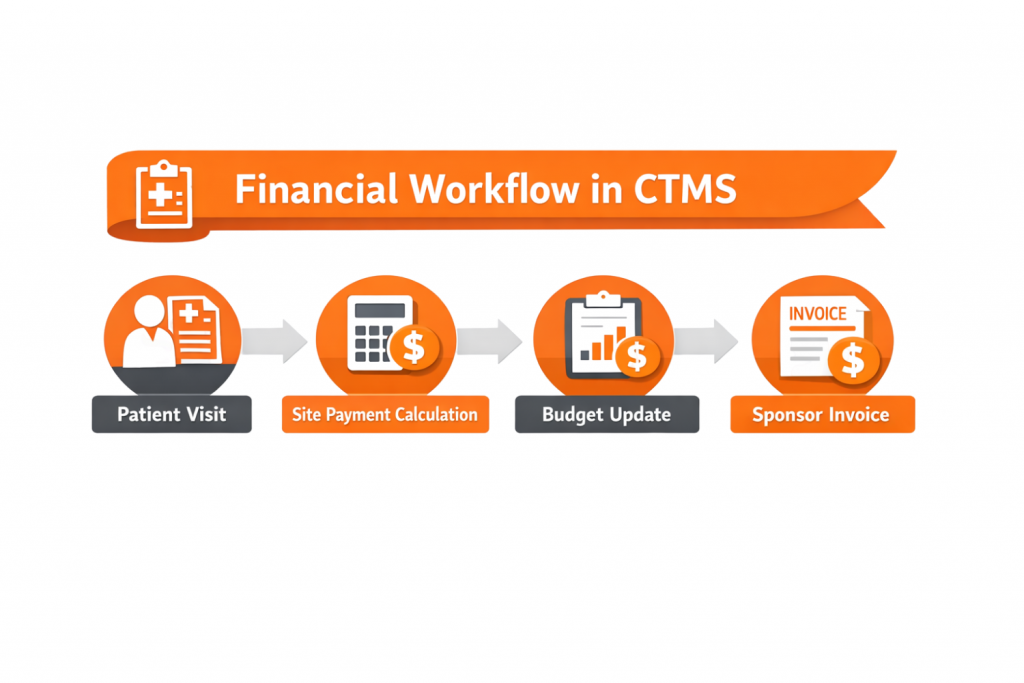
A key advantage of a CTMS is its ability to connect clinical operations with financial processes.
Clinical events recorded in the system can automatically trigger financial actions.
Examples include:
- A completed patient visit automatically triggers a site payment calculation
- A monitoring visit updates study costs
- A milestone achievement generates a sponsor invoice
This integration ensures that financial data always reflects the latest operational activity.
Modern CTMS platforms such as Flex Databases are designed to support these integrated workflows, helping CROs manage both operational and financial processes within a single system.
This approach reduces manual reconciliation and improves financial accuracy.
Benefits of Using CTMS for CRO Financial Management
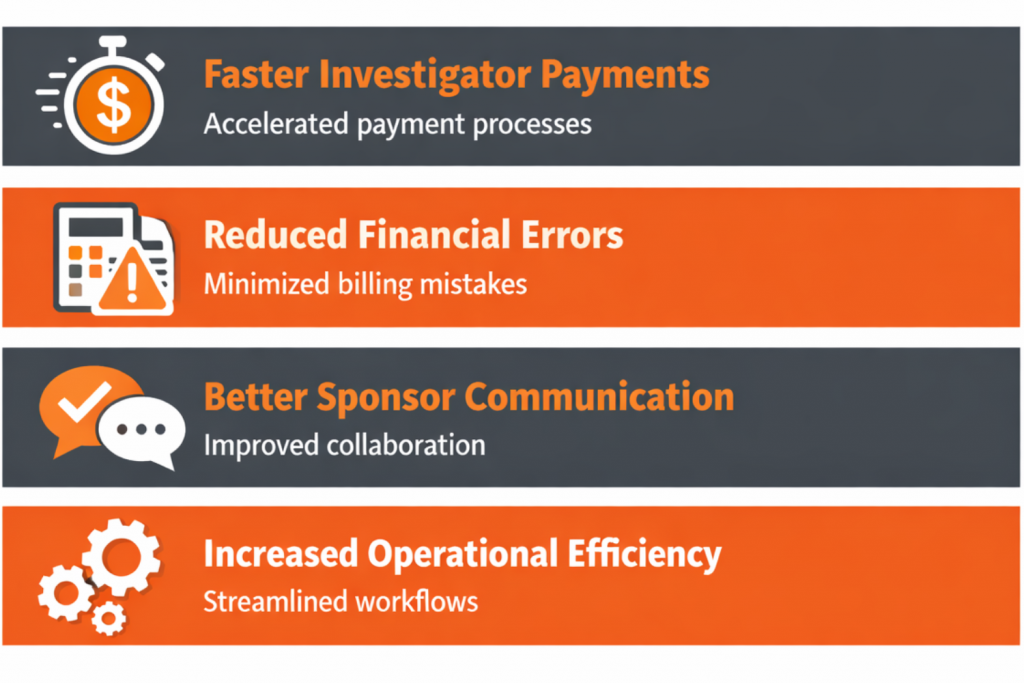
Implementing a CTMS for financial management can significantly improve CRO efficiency and profitability.
Improved Financial Transparency
A centralized CTMS provides real-time visibility into study budgets and financial performance.
Project managers and executives can easily monitor:
- Study expenses
- Revenue generation
- Outstanding payments
This transparency supports better decision-making.
Faster Investigator Payments
Automated payment calculations reduce administrative work and ensure investigators receive payments on time. This improves collaboration between CROs and investigative sites.
Reduced Financial Errors
Automation minimizes the risk of manual errors in payment calculations and invoicing.
Financial data is generated directly from clinical activities, improving accuracy.
Better Sponsor Communication
Sponsors expect clear financial reporting throughout the study lifecycle.
A CTMS enables CROs to provide detailed reports on study progress, costs, and invoicing.
This transparency strengthens sponsor relationships.
Increased Operational Efficiency
By automating financial workflows, CRO teams can focus more on study management rather than administrative tasks. This leads to improved operational efficiency across clinical programs.
CTMS Financial Management vs Spreadsheets for CROs
Many CROs initially manage clinical trial finances using spreadsheets. While spreadsheets may seem flexible, they quickly become difficult to manage as studies grow in complexity.
A Clinical Trial Management System provides structured financial management tools that allow CROs to control study budgets, automate payments, and generate financial reports.
The table below compares spreadsheet-based financial management with CTMS-based financial management.
| Feature | Spreadsheets | CTMS |
| Study budget management | Manual budget tracking across multiple files | Centralized budget planning and tracking |
| Investigator payment calculation | Manual formulas and calculations | Automated payment calculation based on study events |
| Site payment tracking | Requires manual updates | Automated payment tracking |
| Sponsor invoicing | Prepared manually | Automated invoice generation |
| Financial reporting | Limited reporting capabilities | Real-time financial dashboards and reports |
| Audit trail | Limited version control | Full audit trail for financial activities |
| Integration with clinical data | No integration | Financial workflows linked to clinical events |
| Multi-study management | Difficult to maintain | Centralized management across multiple trials |
Key Questions CROs Should Ask When Choosing a CTMS
Selecting the right CTMS is an important decision for CROs.
Organizations should evaluate financial capabilities carefully.
Key questions include:
- Does the CTMS support investigator payment automation?
- Can the system manage multi-site study budgets?
- Does the CTMS generate sponsor invoices automatically?
- Can financial workflows be linked to clinical events such as patient visits or monitoring activities?
- Does the system provide financial reporting across multiple studies?
A CTMS designed specifically for CRO operations should address these requirements.
Conclusion
Financial management plays a critical role in the success of clinical trials. CROs must manage complex budgets, investigator payments, sponsor invoicing, and study profitability across multiple projects.
Manual financial tracking methods, such as spreadsheets, often lead to inefficiencies, errors, and limited visibility into financial performance.
A CTMS provides a centralized platform for managing both operational and financial aspects of clinical trials. By integrating clinical activities with financial workflows, a CTMS helps CROs automate payments, generate invoices, and maintain accurate financial records.
Platforms such as Flex Databases allow CROs to manage clinical trial budgets, investigator payments, and financial reporting within a single system, improving transparency and operational efficiency.
As clinical trials continue to grow in complexity, implementing a CTMS for financial management can help CROs maintain control over study budgets, improve sponsor communication, and support long-term profitability.
FAQ
What is CTMS financial management for CROs?
CTMS financial management refers to the use of a Clinical Trial Management System to manage study budgets, investigator payments, and sponsor invoices. Instead of tracking financial activities in spreadsheets, CROs can use a CTMS to automate payment calculations, track study costs, and monitor project profitability.
Modern systems such as Flex Databases integrate financial workflows directly with clinical operations.
How does a CTMS help CROs manage clinical trial budgets?
A CTMS helps CROs manage clinical trial budgets by centralizing all financial information related to a study. The system allows organizations to create study budgets, track costs at the site level, monitor budget changes after protocol amendments, and compare planned versus actual expenses.
This improves financial visibility across multiple trials
Can a CTMS automate investigator payments?
Yes. Many CTMS platforms automate investigator payment calculations based on study activities such as patient visits, completed procedures, or study milestones.
Automation ensures that site payments are calculated accurately and reduces administrative workload for CRO finance teams.
Why are investigator payments difficult to manage manually?
Investigator payments are complex because they depend on many factors, including patient enrollment, visit schedules, and study milestones.
When payments are managed in spreadsheets, CROs must manually track these events and calculate payments. This process is time-consuming and increases the risk of errors or delayed payments.
Can a CTMS generate sponsor invoices automatically?
Yes. Many CTMS platforms support automated invoice generation for sponsors. The system can generate invoices based on predefined rules such as patient recruitment numbers, completed monitoring visits, or study milestones.
This helps CROs reduce delays in billing and maintain consistent financial reporting.
What financial reports should a CTMS provide?
A CTMS should provide financial reports that help CROs monitor study performance. Common reports include:
- Study budget versus actual costs
- Investigator payment summaries
- Sponsor invoice reports
- Study profitability analysis
These reports help CRO management evaluate financial performance across multiple trials.
How does CTMS improve financial transparency in clinical trials?
A CTMS centralizes operational and financial data in one system. Because financial workflows are connected to clinical activities, organizations gain real-time visibility into study budgets, payments, and revenues.
This transparency allows CROs to track financial performance and respond quickly to budget changes.
What features should CROs look for in a CTMS for financial management?
When evaluating CTMS platforms, CROs should look for financial features such as:
- Study budget planning and tracking
- Automated investigator payment calculation
- Sponsor invoice generation
- Financial reporting and profitability analysis
- Integration with other clinical systems
These capabilities help organizations manage financial processes efficiently.
Can CTMS integrate financial data with other clinical systems?
Yes. Modern CTMS platforms can integrate with other clinical systems, including electronic data capture platforms and trial master file systems.
For example, systems like Flex Databases support integrations that allow clinical and financial data to remain synchronized across platforms.
Why is financial management important for CRO profitability?
Financial management is critical because CROs must ensure that clinical trials remain within budget while generating expected revenue.
Without proper financial oversight, organizations may experience delayed payments, incorrect invoicing, or reduced project profitability. A CTMS helps CROs maintain financial control and improve operational efficiency.