Risk-Based Monitoring (RBM) in Clinical Trials: A Comprehensive Guide to Modern Oversight
April 1, 2026
For decades, the clinical research industry operated under a manual, labor-intensive oversight model. The gold standard was 100% Source Data Verification (SDV) – a process where Clinical Research Associates (CRAs) traveled to sites to painstakingly cross-reference every data point in a Case Report Form against medical records. However, as trials have become more data-saturated and globally distributed, this “one-size-fits-all” approach has proven to be both inefficient and prone to overlooking systemic quality issues.
Today, Risk-Based Monitoring (RBM) in clinical trials has evolved from a progressive trend to a regulatory mandate. Following the ICH E6 (R2) and the upcoming (R3) guidelines, sponsors and CROs are now expected to implement a proactive, “Quality by Design” approach to trial oversight.
RBM is not simply about doing less monitoring; it is about monitoring smarter. By leveraging centralized data analytics and identifying “Critical to Quality” (CtQ) factors, RBM allows study teams to focus their resources where they matter most: protecting patient safety and ensuring the integrity of primary endpoints.
In this guide, we explore the intricacies of RBM in clinical trials, its impact on operational efficiency, and how a unified eClinical ecosystem integrating CTMS, EDC, and eTMF is the essential engine for modern, risk-driven oversight.
What is Risk-Based Monitoring in Clinical Trials?
Risk-Based Monitoring (RBM) is a strategic approach to clinical trial oversight that directs monitoring resources to the areas of greatest risk. Instead of treating every data point with equal weight, RBM focuses on the “critical to quality” (CtQ) factors that protect patient safety and the reliability of trial results.
At its core, RBM in clinical trials is about moving away from the “one-size-fits-all” mentality. In a traditional monitoring model, Clinical Research Associates (CRAs) spend a significant portion of their time on-site, often up to 60-80% of their billable hours verifying every single entry in the Case Report Form (CRF) against medical records. This 100% Source Data Verification (SDV) approach was designed for an era of paper records and simpler protocols; in today’s high-volume data environment, it often obscures systematic errors behind a mountain of minor transcription checks.
The Shift to Data-Driven Oversight
RBM in clinical trials shifts this focus toward a hybrid model of centralized, remote, and targeted monitoring. Rather than a calendar-based schedule of site visits, monitoring activities are triggered by real-time data performance.
This modern methodology is built on three specific pillars:
- Centralized Monitoring: Using unified software to aggregate data from all sites, allowing for the identification of statistical outliers or unusual patterns that suggest a site may be struggling or non-compliant.
- Off-site/Remote Monitoring: Reviewing digital documents and data entries in real-time, reducing the need for physical travel while maintaining continuous oversight.
- Targeted SDV: Strategically choosing to verify only the most critical data such as primary endpoints and serious adverse events (SAEs) which has been proven to maintain trial integrity while drastically reducing administrative burden.
Regulatory Alignment: ICH E6 (R2) and Beyond
This transition isn’t just an operational choice; it is a response to global regulatory shifts. The ICH E6 (R2) Addendum explicitly requires sponsors to develop a systematic, risk-based approach to monitoring. Regulators like the FDA and EMA have recognized that a well-executed RBM in clinical trials strategy provides better protection for trial subjects than traditional methods, as it identifies safety signals and data trends much faster than a retrospective on-site visit ever could.
By integrating these risks into a centralized Clinical Trial Management System (CTMS), companies can transition from being reactive “checkers” to proactive “quality managers,” ensuring that the focus remains on the trial’s most vital outcomes.
The Shift from Traditional to Risk-Based Approaches
| Operational Feature | Traditional Monitoring (Manual) | Risk-Based Monitoring (RBM) |
| Site Oversight Strategy | Fixed, calendar-based intervals (e.g., every 4–8 weeks) | Adaptive & Triggered: Driven by site-specific performance and risk indicators. |
| Data Verification (SDV) | 100% SDV: Labor-intensive verification of every CRF entry. | Targeted SDV: Strategic focus on “Critical to Quality” (CtQ) data and primary endpoints. |
| Data Review Velocity | Retrospective: Reviews often occur weeks or months after data entry. | Real-Time: Continuous monitoring via centralized eClinical systems and dashboards. |
| Monitoring Environment | Predominantly on-site; travel-heavy for CRAs. | Hybrid: Integrated centralized, remote, and targeted on-site activities. |
| Primary Objective | Identifying random transcription errors and “box-ticking.” | Systemic Integrity: Ensuring subject safety, protocol compliance, and scientific validity. |
| Regulatory Alignment | Pre-ICH E6 (R2) standards; reactive quality control. | ICH E6 (R2)/(R3) Compliant: Proactive “Quality by Design” (QbD) methodology. |
The Four Core Pillars of RBM in Clinical Trials
A successful RBM in clinical trials strategy is not a single activity, but a multi-layered framework integrated directly into the study protocol. To meet modern regulatory expectations, four foundational components must work in tandem.
Risk Assessment and Management (RAMP)
Risk management begins during the study design phase, well before the first patient is enrolled. Using tools like a Risk Assessment and Categorization Tool (RACT), sponsors identify potential threats to data integrity and subject safety.
- Action: Risks are categorized by Impact, Probability, and Detectability.
- Outcome: A living Risk Management Plan that defines which “Critical to Quality” (CtQ) factors require the most intensive oversight.
Centralized Monitoring: The “Analytical Engine”
Centralized monitoring is the operational heart of RBM in clinical trials. It involves the remote evaluation of accumulating data from across all investigative sites to identify trends that on-site monitoring might miss.
- Statistical Analysis: Identifying outliers, unusual data distributions, or “too perfect” data that may indicate fraud or poor training.
- Key Risk Indicators (KRIs): Automated tracking of metrics such as query aging, screen failure rates, and protocol deviations to “score” site performance in real-time.
Targeted & Reduced Source Data Verification (SDV)
Traditional monitoring relies on 100% SDV, which is statistically proven to identify less than 3% of critical errors. RBM optimizes resources by focusing verification only on the data that truly impacts the trial’s outcome.
- Critical Data Focus: Prioritizing primary endpoints, eligibility criteria, and Serious Adverse Events (SAEs).
- Strategic Sampling: Verifying a statistically significant subset of data rather than every single CRF entry, allowing CRAs to focus on high-value site management.
Triggered On-Site Monitoring
In an RBM model, site visits are driven by data, not the calendar. Instead of routine “check-ins” every six to eight weeks, on-site monitoring is “triggered” by specific performance thresholds.
- Risk Triggers: If centralized monitoring detects a spike in SAEs, a lack of reported deviations, or high staff turnover at a specific site, a CRA is deployed immediately.
- Value-Added Visits: On-site time is spent on root-cause analysis and investigator training rather than administrative data entry checks.
Benefits of Implementing RBM in Clinical Trials Management
The adoption of RBM in clinical trials is no longer a theoretical exercise; it is a data-proven methodology for improving trial ROI. When sponsors and CROs move away from 100% SDV, they unlock significant efficiencies across the study lifecycle.
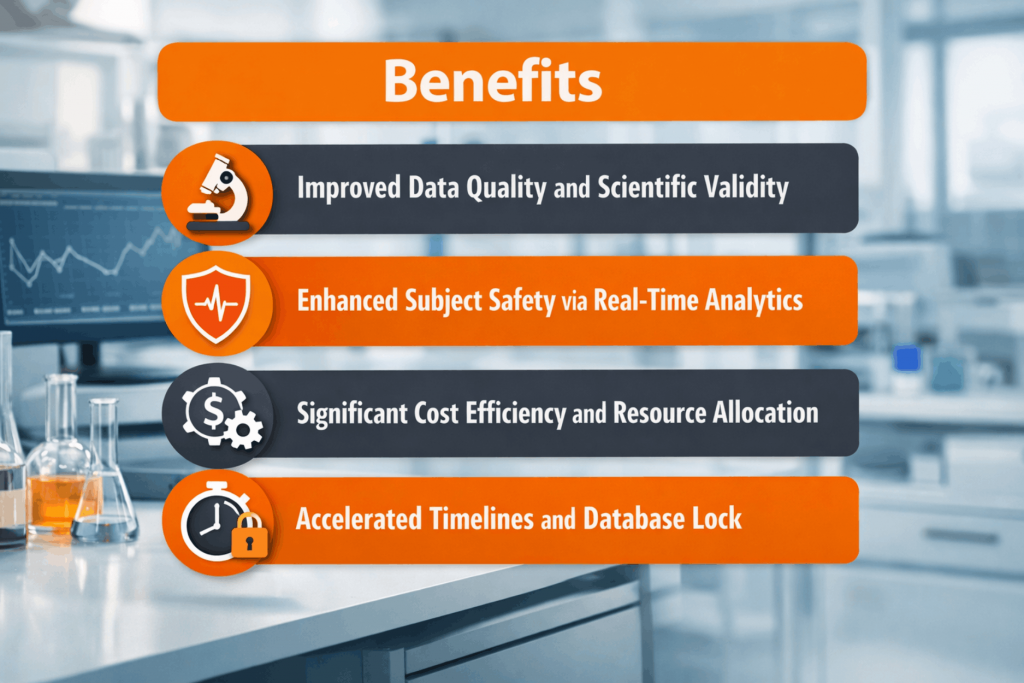
Improved Data Quality and Scientific Validity
Traditional 100% SDV is surprisingly ineffective at catching the errors that actually matter. Research indicates that manual SDV identifies less than 3% of critical data errors that impact primary study endpoints.
- Focus on Systematic Error: RBM identifies “data clusters” and procedural non-compliance across sites, which account for the vast majority of regulatory findings.
- Result: Cleaner databases with a higher “signal-to-noise” ratio, ensuring that the trial’s scientific conclusions are robust.
Enhanced Subject Safety via Real-Time Analytics
In a traditional model, a safety trend might not be spotted until a CRA performs an on-site monitoring visit weeks after the event. RBM in clinical trials utilizes centralized monitoring to close this “safety gap.”
- Faster Signal Detection: Centralized dashboards can identify a 15-20% increase in specific Adverse Events (AEs) across global sites in near real-time.
- Proactive Protection: By identifying safety outliers early, sponsors can pause enrollment or adjust protocols before more subjects are put at risk.
Significant Cost Efficiency and Resource Allocation
On-site monitoring is often the single largest line item in a clinical trial budget, frequently consuming 25-30% of total study costs.
- Reduced Travel Costs: Transitioning to RBM can reduce the number of on-site visits by 20-40%, significantly lowering T&E (Travel and Expense) budgets.
- High-Value Labor: Instead of spending 8 hours on-site “ticking boxes,” CRAs spend their time on site relationship management and investigator training activities that have a 3x higher impact on site performance.
Accelerated Timelines and Database Lock
The “firefighting” that typically occurs at the end of a study resolving hundreds of old queries is the primary cause of delayed database locks.
- Continuous Data Cleaning: Because RBM requires data to be entered and queried in real-time, the “cleaning” happens throughout the study.
- Faster Locks: Studies utilizing a unified CTMS and EDC with RBM capabilities often achieve database lock 1-2 weeks faster than those using traditional retrospective monitoring.
| Metric | Traditional Monitoring | Risk-Based Monitoring (RBM) |
| SDV Coverage | 100% (Manual) | 10-25% (Targeted/Critical) |
| On-Site Monitoring Costs | High (Fixed Schedule) | Lowered by 25% average |
| Error Detection Rate | Low (Random errors) | High (Systemic/Safety trends) |
| Query Resolution Time | 30+ Days (Retrospective) | < 5 Days (Real-time) |
The 5-Step Framework for RBM Implementation
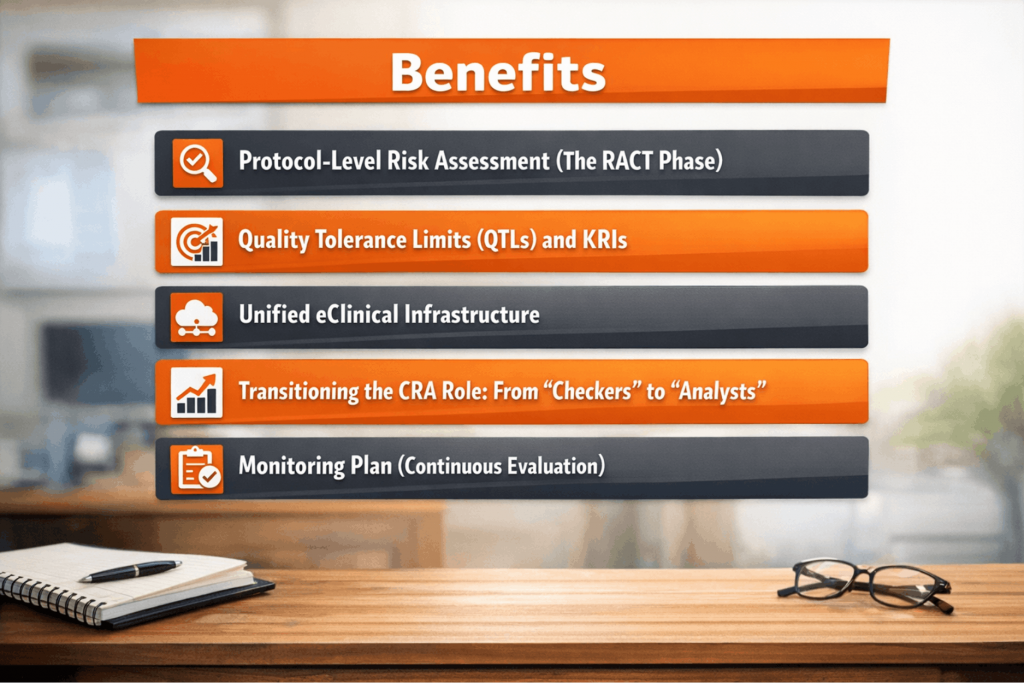
Protocol-Level Risk Assessment (The RACT Phase)
Before the study starts, use a Risk Assessment and Categorization Tool (RACT) to identify “Critical to Quality” (CtQ) factors.
- Software Requirement: Your system should allow you to digitize the RACT, assigning scores to categories like Protocol Complexity, Safety Profile, and Site Experience.
- Goal: Define which data points (e.g., primary endpoints, SAEs) require 100% verification and which can be monitored via sampling.
Quality Tolerance Limits (QTLs) and KRIs
You cannot manage what you do not measure. Define the parameters for “acceptable” data behavior.
- Quality Tolerance Limits (QTLs): These are study-wide thresholds (e.g., “The trial is at risk if more than 10% of subjects drop out”).
- Key Risk Indicators (KRIs): These are site-level metrics (e.g., “A site is high-risk if they have not answered a query in 5 days”).
- Software Requirement: An integrated CTMS that automatically pulls data from the EDC to flag when these thresholds are breached.
Unified eClinical Infrastructure
RBM fails in a fragmented environment. To ensure real-time oversight, your technology stack must be interconnected.
- The “Golden Thread”: Data should flow seamlessly between the EDC (clinical data), eTMF (document compliance), and CTMS (operational metrics).
- Visualization: Use automated dashboards rather than manual reports. This allows Lead CRAs to see “Red-Amber-Green” risk statuses across all global sites at a single glance.
Transitioning the CRA Role: From “Checkers” to “Analysts”
The most significant hurdle is the human element. Monitoring teams must shift their focus from catching typos to performing root-cause analysis.
- Analytical Monitoring: Instead of checking 100 entries, the CRA reviews the site’s trend. If the software shows a site is consistently late on data entry, the CRA’s task is to provide targeted training or investigator support.
- Software Requirement: A Learning Management System (LMS) integrated with the CTMS to assign “re-training” tasks automatically when a site’s risk score rises.
Monitoring Plan (Continuous Evaluation)
Risk is dynamic. A site that is “Green” in Month 2 might become “Red” in Month 6 due to staff turnover or high enrollment.
- Adaptive Monitoring: Your Monitoring Plan must allow for shifting resources. If Site A is performing perfectly, reduce their on-site visits and redirect that CRA to Site B, which is struggling with protocol deviations.
- Software Requirement: Real-time risk-scoring engines that update daily, ensuring your monitoring efforts are always aligned with the current risk landscape.
The Role of Technology: Turning Data into Risk Intelligence
In a traditional study, “monitoring” is a human activity. In RBM in clinical trials, technology acts as a force multiplier. Without a robust eClinical infrastructure, RBM is merely “less monitoring” rather than “smarter monitoring.” Modern platforms transform fragmented data points into a unified Risk Intelligence Engine.
Moving Beyond Manual Data Silos
The greatest barrier to effective RBM is the “Data Lag.” If your clinical data is in an EDC, your site metrics are in a CTMS, and your document compliance is in an eTMF, you cannot see a holistic risk profile.
- The Unified Solution: A single-platform approach (like Flex Databases) ensures that a risk identified in one module (e.g., a site staff member’s training expiring in the LMS) immediately updates the site’s risk score in the CTMS.
- Real-Time Interconnectivity: This eliminates the need for “data reconciliation” meetings, allowing Study Managers to act on yesterday’s data, not last month’s.
Automated Key Risk Indicators (KRIs) & Thresholds
Modern RBM software doesn’t just show data; it evaluates it against pre-defined Quality Tolerance Limits (QTLs). When a site crosses a threshold, the system triggers an automated alert.
| Key Risk Indicator (KRI) | What it Signals in RBM | Strategic Action |
| Rate of Screen Failures | Potential protocol misunderstandings or over-ambitious enrollment. | Targeted Investigator training via LMS. |
| AE/SAE Reporting Rates | Under-reporting (if too low) or safety signals (if too high). | Immediate Medical Monitor review. |
| Data Entry Timeliness | Site “burnout” or lack of administrative resources. | Triggered “Supportive” on-site visit. |
| Query Aging/Resolution | Poor site engagement or communication breakdowns. | Escalation to the Principal Investigator. |
| Consent Form Deviations | High regulatory/compliance risk. | 100% SDV for informed consent documents. |
Advanced Visualization: The “Red-Amber-Green” (RAG) Status
Instead of scrolling through 200-page monitoring reports, study teams use interactive dashboards.
- Heat Maps: Visualizing global site performance to identify geographic trends (e.g., all sites in one region struggling with a specific lab procedure).
- Trend Analysis: Comparing a site’s current performance against its own historical baseline to spot “slippage” before it becomes a major protocol deviation.
The “Audit Trail” of Risk Decisions
Regulators (FDA/EMA) don’t just want to see that you monitored a trial; they want to see why you made certain decisions.
- Evidence of Oversight: Technology provides a digital audit trail of every risk alert and the subsequent action taken.
- Compliance: If you chose to skip an on-site visit because a site was “Green,” the software provides the data-driven justification for that decision during a regulatory inspection.
Frequently Asked Questions
1. What is the difference between RBM and Remote Monitoring?
Remote monitoring is a method of viewing data from a distance, while RBM in clinical trials is a strategy for prioritizing resources based on site risk. You can monitor remotely without an RBM strategy, but modern RBM almost always utilizes remote tools.
2. Does the FDA support Risk-Based Monitoring?
Yes. The FDA, EMA, and PMDA explicitly encourage Risk-Based Monitoring in clinical trials through guidance like ICH E6 (R2) to enhance subject safety and data integrity over traditional 100% SDV.
3. Is RBM only for large pharmaceutical companies?
No. Small-to-mid-sized biotechs often see the highest ROI from RBM in clinical trials because it allows them to scale operations and maximize limited budgets by focusing on critical data.
4. Does RBM eliminate on-site monitoring visits entirely?
Rarely. The goal of RBM in clinical trials is to replace “calendar-based” visits with “triggered” visits, ensuring CRAs go on-site only when data indicators suggest a need for hands-on intervention.
5. What is a KRI in Risk-Based Monitoring?
A Key Risk Indicator (KRI) is a metric used to evaluate site performance. Common KRIs include adverse event reporting rates, screen failure percentages, and data entry timeliness.
6. How does RBM in clinical trials improve patient safety?
By using centralized monitoring, sponsors can identify safety signals and cross-site trends in real-time, allowing for faster medical intervention than traditional retrospective on-site reviews.
7. What is Source Data Verification (SDV) in an RBM model?
In RBM in clinical trials, 100% SDV is replaced by Targeted SDV. This focuses verification only on “Critical to Quality” (CtQ) data, such as primary endpoints and eligibility criteria.
8. What is a RACT?
The Risk Assessment and Categorization Tool (RACT) is a document or software module used at the start of a trial to identify, evaluate, and mitigate potential risks to the study.
9. Can RBM reduce clinical trial costs?
Yes. By reducing unnecessary travel and focusing on high-risk areas, RBM in clinical trials can reduce monitoring-related costs by 20% to 40% without compromising quality.
10. What is centralized monitoring?
Centralized monitoring is a remote evaluation of accumulating trial data by a central team to identify statistical outliers, data trends, or potential fraud across all investigative sites.
11. Is RBM mandatory for regulatory compliance?
While not strictly “mandatory” for every phase, ICH E6 (R2) makes it a requirement for sponsors to have a systematic, risk-based approach to monitoring to meet modern GCP standards.
12. How does RBM impact the role of a CRA?
CRAs transition from “data checkers” to “site managers” and “analysts.” They spend less time on transcription checks and more time on root-cause analysis and investigator training.
13. What is a “Triggered Visit” in RBM?
A triggered visit is an on-site monitoring event initiated by a site’s risk score crossing a pre-defined threshold, such as a sudden spike in protocol deviations or late data entry.
14. What technology is needed for Risk-Based Monitoring?
Effective RBM in clinical trials requires an integrated eClinical suite, typically combining a CTMS, EDC, and centralized dashboards to track KRIs in real-time.
15. Does RBM speed up database lock? Yes. Because RBM in clinical trials encourages real-time data entry and query resolution, the “end-of-study” cleaning phase is significantly shortened, leading to faster database locks.